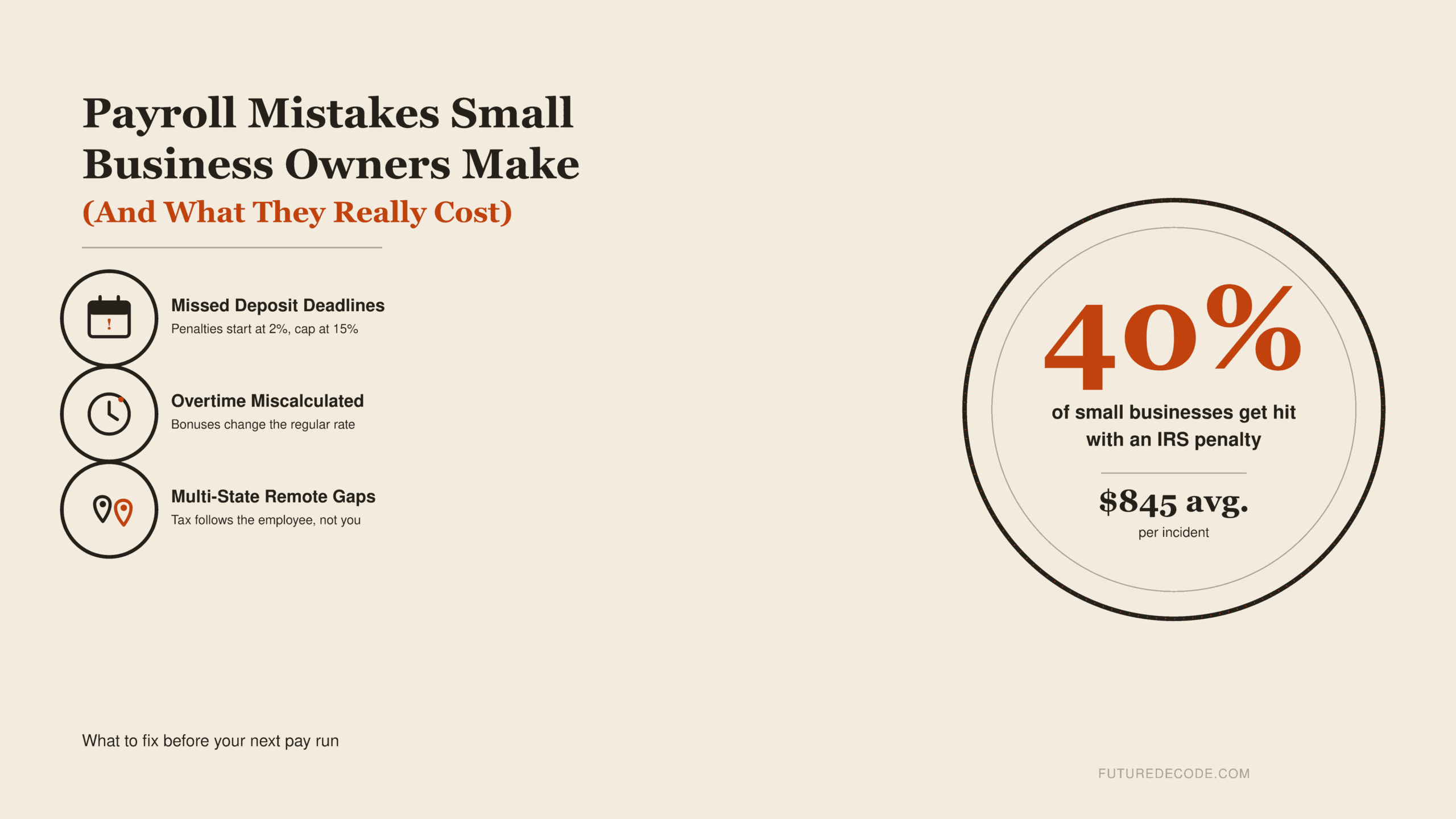
Forty percent of small businesses get hit with IRS penalties every year, averaging $845 per incident, according to IRS and BlinkPayroll data. For a business running payroll on 5 people, that’s not a rounding error – it’s real money out of a thin margin. The payroll mistakes small business owners make are rarely about carelessness. They’re about not knowing the rules changed, or never knowing them at all.
This post is written for small business owners who handle payroll for a small team themselves and want to stop guessing. You’ll learn exactly what triggers the biggest IRS penalties, how to calculate overtime correctly when bonuses are involved, and what to do if you have even one remote employee working across state lines. No accounting degree required.
What Payroll Mistakes Small Business Owners Make With Tax Deposits
Missing a payroll tax deposit deadline is one of the most expensive payroll mistakes small business owners make, and the penalty grows the longer it sits unpaid.
Employers must deposit withheld employment taxes electronically through the Electronic Federal Tax Payment System, either monthly or semi-weekly. Which schedule you’re on isn’t a choice. The IRS sets it annually based on your total tax liability during a 4-quarter lookback period, so it can change year to year without you doing anything differently.
A semi-weekly schedule works differently from a monthly one. If you’re on it, taxes withheld from a Wednesday, Thursday, or Friday payroll are due the following Wednesday. Taxes from a Saturday through Tuesday payroll are due the following Friday. Missing either window starts the same penalty clock.
Miss the deadline by 1 to 5 days and the IRS charges a 2% penalty on the unpaid balance. Six to 15 days late, it jumps to 5%. Past 15 days, it’s 10%. If the balance is still unpaid 10 days after an IRS notice arrives, the penalty hits the statutory maximum of 15%, according to GATP Solutions’ compliance analysis. Interest also accrues on top of the penalty until the balance is settled.
One Texas e-commerce business learned this the hard way. A three-day delay in customer payment settlements pushed a $12,000 payroll tax deposit four days past deadline. That landed them squarely in the 5% penalty tier, a $600 hit for a four-day miss. No fraud, no bad intent, just a cash-flow timing problem that turned into a statutory penalty.
Good record-keeping makes this easier to catch before it becomes a penalty. Keep a simple log of every deposit date, amount, and confirmation number, separate from your general bookkeeping. If a deposit ever looks off, you want to catch it within days, not at year-end.
Quick Win: Set a calendar reminder 3 days before your deposit deadline, not on the day itself.
How to Calculate Overtime Pay When Employees Earn Bonuses
Under the Fair Labor Standards Act, overtime is the required 1.5x pay rate for hours worked beyond 40 in a single workweek. Most owners calculate it correctly for straight hourly wages and then get it wrong the moment a bonus enters the picture.
The rate you owe overtime on isn’t your employee’s base hourly wage. It’s the “regular rate of pay”: total weekly earnings, including non-discretionary bonuses, commissions, and shift differentials, divided by total hours worked that week.
Regular Rate = Total Earnings (base pay + bonuses) ÷ Total Hours Worked
Here’s how that plays out with real numbers. Say an hourly employee earns $18 an hour, works 45 hours in a week, and receives a $150 non-discretionary safety bonus that same week. Total earnings for the week are (45 × $18) + $150, which comes to $960. Divide that by the 45 hours actually worked, and the regular rate is $21.33, not $18.
That $3.33 difference matters. The employee is owed an extra half-time premium on the 5 overtime hours, calculated as $21.33 × 0.5 × 5, which works out to $53.33 on top of straight-time pay for those hours. Skip the bonus in that calculation, and you’ve underpaid overtime without realizing it.
Salaried non-exempt employees follow the same math, just with an extra step. You divide the weekly salary by 40 to find the base hourly equivalent, then add any non-discretionary bonus before dividing by total hours worked. The underlying rule doesn’t change.
The distinction that trips people up is “non-discretionary” versus “discretionary.” A bonus tied to a formula, attendance, or performance target is non-discretionary and must be folded into the regular rate. A true surprise bonus, given with no prior promise, generally isn’t.
When in doubt, assume it counts. This kind of omission surfaces fast in a Department of Labor audit.
Quick Win: Before running payroll, ask “did anyone earn a bonus or differential this week?” If yes, recalculate the regular rate before applying overtime.
How to Pay Remote Employees Who Work in Different States
Multi-state tax nexus is one of the fastest-growing compliance risks for small teams, and it’s a gap most payroll advice online skips entirely. The moment an employee works from a different state than your business is headquartered in, you may owe withholding tax and unemployment contributions in their state, not just yours.
This catches small business owners off guard because it isn’t triggered by a policy decision. It’s triggered by geography. An employee who relocates, or who was hired remote from day one, creates a tax obligation in their state of residence the moment they start earning wages there.
Maria runs a 5-person property management firm in Arizona. Three of her employees work remotely from neighboring states. Because she never registered with those states’ tax authorities or adjusted state withholding, an audit surfaced the gap. The result was back taxes, interest charges, and mandatory amended tax returns filed across two separate tax years.
The obligation follows the employee’s physical work location, not their home address on file or your company’s state of incorporation.A worker who splits time between two states in a single month can trigger withholding requirements in both. That’s why many small businesses now ask remote hires to confirm their primary work state in writing before the first pay run.
Multi-state compliance also affects unemployment insurance. Once you register in a new state, you’ll typically owe state unemployment tax contributions there too, calculated on that employee’s wages. Budgeting for this before you approve a remote move avoids an unpleasant surprise on your next quarterly filing.
The registration itself isn’t the hard part. It’s usually a form and a fee. The hard part is knowing it’s required before an audit tells you, and enforcement here is only tightening, according to compliance analysis from GATP Solutions.
Quick Win: Before hiring or approving a remote move, check whether that employee’s new state requires separate tax registration and withholding.
FAQ
Q: What’s the most common payroll mistake small business owners make?
A: Relying on manual spreadsheets. Manual entry carries a 33% error rate, and each mistake costs roughly $291 in corrective labor and banking fees — on top of any IRS penalty that error triggers.
Q: How do I legally determine if a worker is an employee (W-2) or a contractor (1099)?
A: The IRS looks at three factors: behavioral control (who directs the work), financial control (who bears the financial risk), and relationship dynamics (contracts, benefits, permanence). A signed 1099 agreement doesn’t override these standards if the reality looks like employment.
Q: How much does payroll software cost for a 5-employee business?
A: Full-service platforms typically charge a $35–$50 monthly base fee plus $6–$12 per employee. For a 5-person team, expect to pay roughly $65–$140 a month depending on features like multi-state filing.
Q: How long must you keep payroll records for compliance?
A: At least 4 years from when the tax was due or paid, per IRS and Department of Labor rules. That includes timesheets, canceled checks, W-4/W-2 forms, and tax deposit records. Some states require longer.
Q: What counts as “regular rate of pay” when calculating overtime?
A: Everything non-discretionary you paid that week — base wages, performance or attendance bonuses, commissions, and shift differentials. Purely discretionary bonuses, like a surprise holiday gift with no prior promise, are the main exception.
Don’t Let Payroll Mistakes Small Business Owners Make Become Your Next IRS Notice
Deposit deadlines, overtime math, and multi-state withholding are the three places payroll for a 5-person team quietly goes wrong. None of them require an accountant to get right – they require a system that catches the details before the IRS does.

Leave a Reply
You must be logged in to post a comment.