The median small business holds 27 days of cash buffer, according to the JPMorgan Chase Institute. That’s under 4 weeks for the typical owner. A cash flow forecast template for small business shows you where that buffer dips before it does.
Operators often track cash by glancing at a banking app. It works until a profitable month leaves payroll short. The bank balance tells you where you are today. It says nothing about the bills landing next week.
A forecast fixes that by mapping real cash in and out, week by week. This guide covers what goes into the template, how the formulas work, and how to fill it in. You’ll walk away with a 2-tab structure: a 13-week grid for near-term cash and a 12-month grid for planning.
Why a bank balance makes a bad cash flow projection
Your banking app shows what’s there today. It doesn’t show what leaves on Friday.
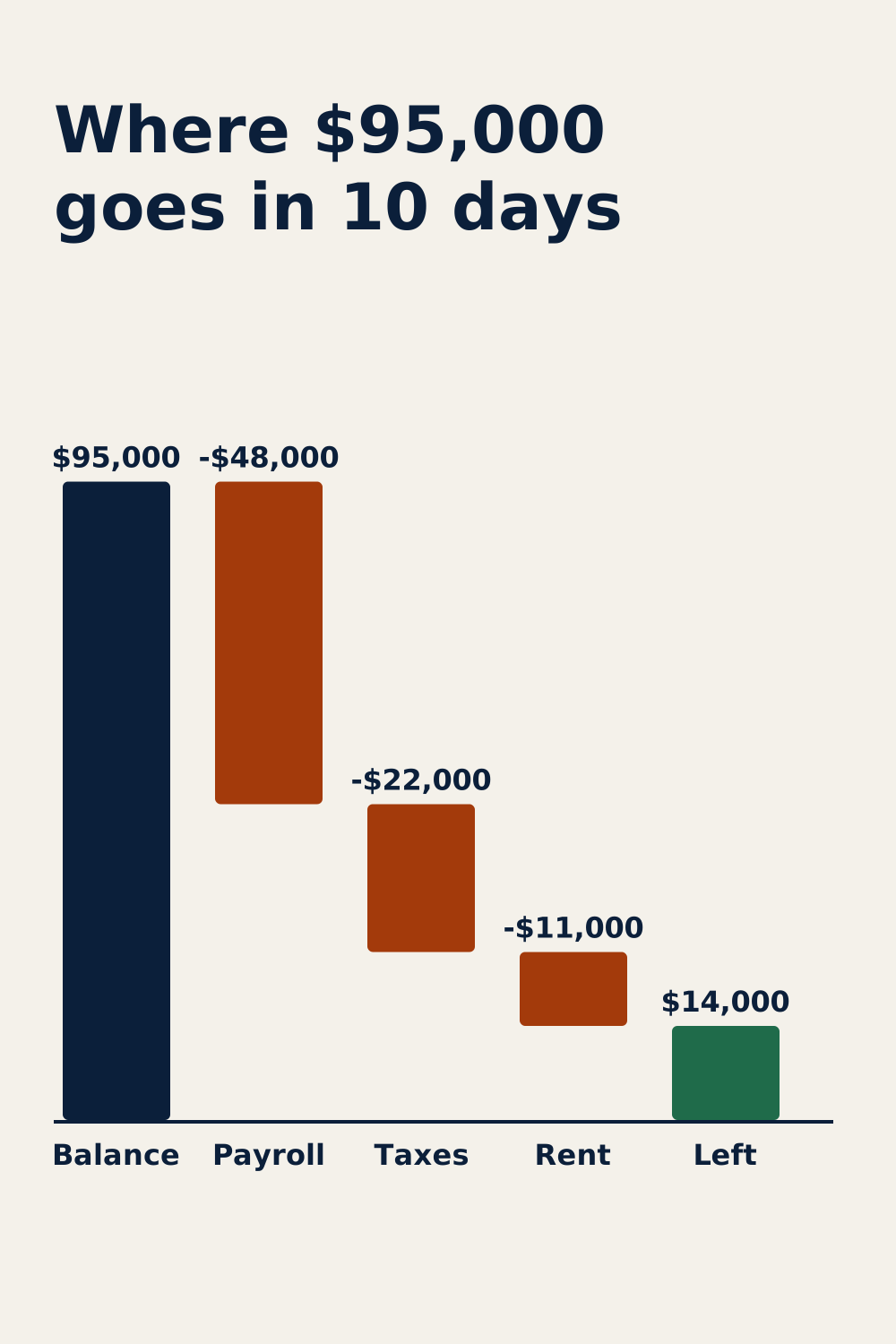
Here’s a vendor example from Zinancial. An owner sees $95,000 in the account. Then $48,000 of payroll, $22,000 of estimated and sales taxes, and $11,000 of rent come due within 10 days. That’s $81,000 out, which leaves $14,000.
Late payers make it worse. In a 2025 Intuit QuickBooks report, 56% of small businesses carried unpaid invoices averaging $17,500 each, with 47% already past due. In its 2026 report, 49% of owners said standard payment processing times create critical or moderate cash-flow gaps.
(A shoebox of receipts at least admits it’s a mess. A banking app looks tidy and lies.)
What a 13-week and 12-month view gives you
A cash flow forecast is a forward-looking calendar of the money expected to enter and leave your bank account. It tracks timing, not profit. That’s the difference between “we made money” and “payroll clears Friday.”
The structure pays off in 3 ways:
- Early warning. Closing balances show dips weeks before payroll, rent, or supplier dates.
- Safer decisions. You can test a hire or an equipment purchase before locking in the cost.
- Lender readiness. A 13-week or 12-month forecast supports a loan or line-of-credit application.
Skip the forecast and you’re guessing with a calculator. How many weeks of payroll could you cover if your biggest client paid 30 days late? (The spreadsheet that quietly lies is usually the one nobody updates.)
What a cash flow forecast template for small business needs inside
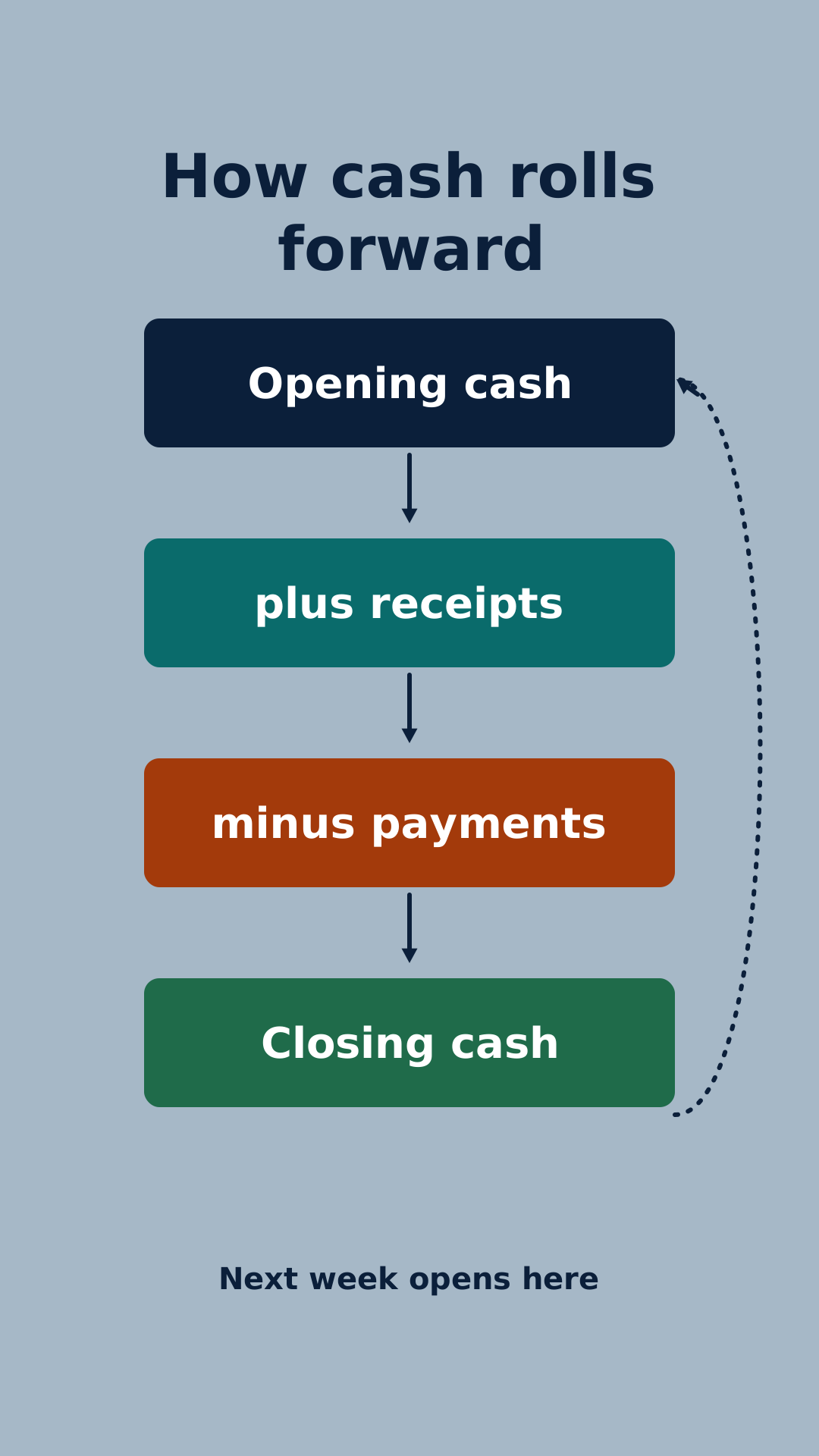
A working template has 2 linked grids. A 13-week weekly tab covers near-term cash, and a 12-month tab covers seasons and big purchases. Each period’s closing cash rolls into the next period’s opening cash.
That’s more than most top results give you. Three of the top 5 results are PDFs, and none of the 5 offers a 13-week weekly tab.
- Baseline input fields: You enter a start date, a minimum cash buffer, and your opening balance from the reconciled bank account. Then come cash inflows (cash sales, collected customer payments, net marketplace payouts, loan deposits), direct costs, overheads like payroll and rent, tax and loan payments, and owner draws. Enter everything in the week the money clears, not the day you send an invoice. The buffer floor matters most: it’s the line that triggers your red alert. Keep tax reserves apart from spendable cash, so a tax bill never looks like free money.
- Calculated outputs: Here’s the math. Net cash flow = total receipts minus total payments. Closing cash = opening cash plus net cash flow, and that number becomes next week’s opening cash. Forecast variance = actual closing cash minus forecast closing cash. Buffer days = current cash divided by daily outflows, which you can compare to the 27-day median.
- Decision indicators: Closing cash cells turn red when they fall below your buffer. A lowest-cash-point marker flags the tightest week. Best, expected, and worst-case tables let you stress-test a hire or a purchase. If your lowest point lands under your floor, you have a decision to make, not a surprise to survive.
Why keep inflows and outflows separate? Because a single netted number hides whether a shortfall comes from slow sales or rising costs. (Combining them is how a spreadsheet learns to lie.)
📋 FRAMEWORK SUMMARY
Rolling Cash Flow Forecast Template
The exact operational structure used to see cash shortfalls before payroll, rent, and tax dates arrive.
Core Input Fields: Opening bank balance, expected cash receipts, scheduled cash payments
Primary Output: Closing cash balance for each week or month, flagged red below your minimum buffer
How to fill in your template step by step
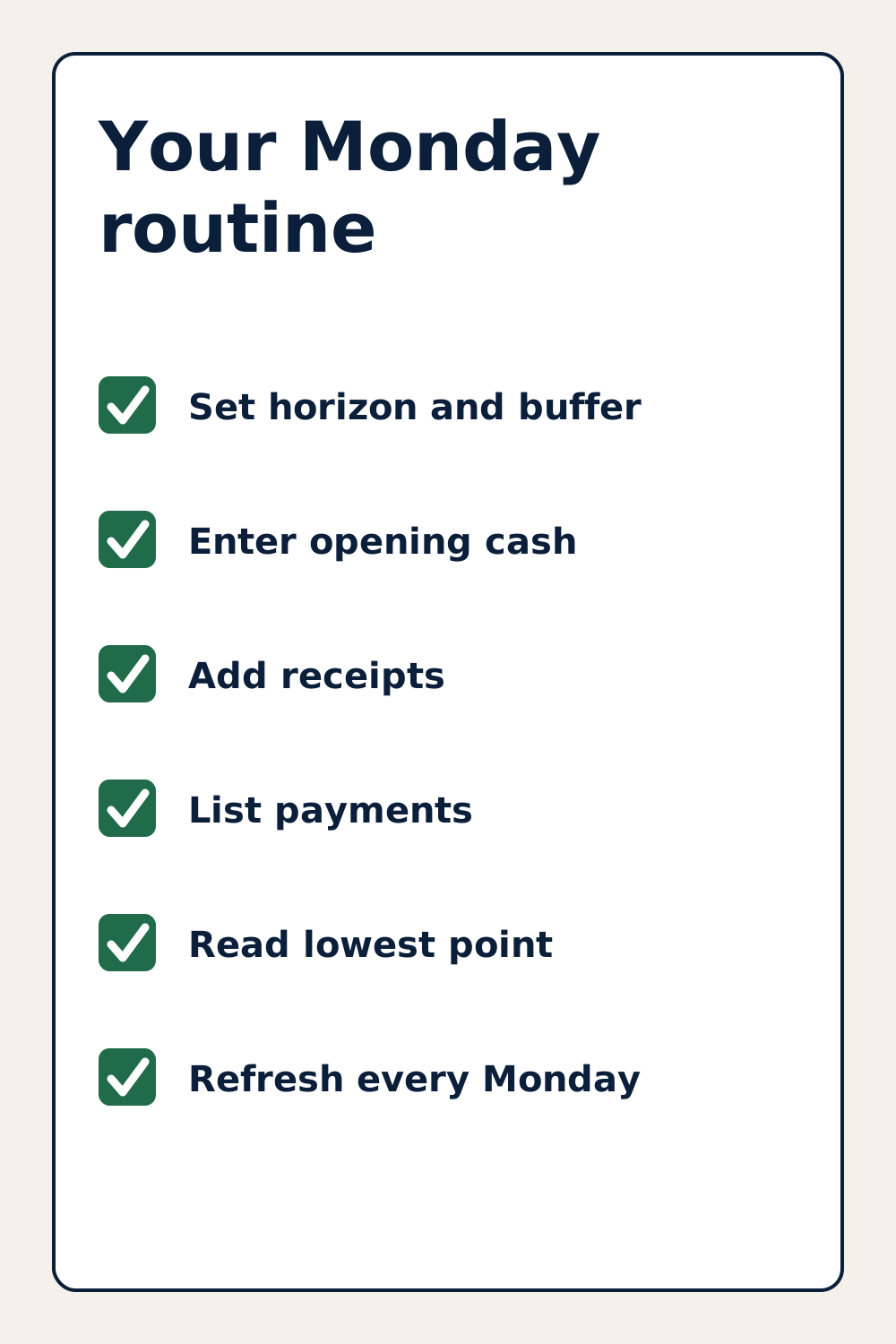
- Pick your horizon and buffer floor. Choose a 13-week weekly grid for tight cash or a 12-month grid for seasonal planning. Then set the minimum cash balance you won’t go below. That floor is what makes the red alert work.
💡 Tip: Start with 13 weeks if payroll is your pressure point, or 12 months if seasons drive your swings. - Enter your opening cash. Use the cleared balance in your business bank account. Ignore the number in your bookkeeping software, because an unreconciled ledger figure can differ from the cleared bank balance.
💡 Tip: Reconcile the account first, or every week after it inherits the error. - Add expected receipts. Put each payment in the week it actually clears. E-commerce sellers should enter net payouts after marketplace fees.
💡 Tip: Use each client’s real days-to-pay, not the Net 30 printed on the invoice. - List every payment. Split direct costs from overheads, then add payroll, rent, supplier bills, debt service, and taxes. Schedule each in its due week. Keep tax money separate from spendable cash.
💡 Tip: Drop annual renewals like insurance and software into the week they hit. - Read the lowest point. Scan the closing balance row for red cells and find the weakest week. If a week dips under your floor, act early: chase overdue accounts, ask for deposits, or trim stock orders.
💡 Tip: Look at the lowest cash point before you look at anything else. - Refresh every Monday. Replace last week’s estimates with actual cleared receipts and payments. Then roll the grid forward one week. If a week missed badly, find out why before you move on.
💡 Tip: Note the biggest variance each week to sharpen next week’s guesses.
Do all 6 and you see next quarter’s cash in a single glance. (Yes, a quarterly guess based on gut feel is also a method. A poor one.)
Common mistakes that break a cash flow forecast
Four errors show up again and again when owners build these from a blank sheet.
- Invoice-date entry: Logging sales when you send the invoice inflates near-term cash. The Fix: Place each receipt in the week cash actually settles, based on how that client really pays, not on the terms printed on the invoice.
- Missing irregular bills: Blank sheets catch rent and utilities but miss quarterly taxes, sales tax remittances, and annual renewals. The Fix: Add every tax and yearly bill in its due period.
- Broken roll-forward links: Overwritten formulas stop closing cash from feeding the next opening balance. The Fix: Lock formula cells with Review > Protect Sheet so routine edits can’t break them.
- Best-case sales as fact: Treating hopeful projections as guaranteed cash leads to hires you can’t fund. The Fix: Anchor the forecast in past sales and add fixed costs only after revenue clears the bank.
(Optimism is a great trait and a terrible line item.)
Frequently asked questions
Q: What is a Cash Flow Forecast?
A: A cash flow forecast is a forward-looking calendar of money expected to enter and leave your business bank account. It shows timing, not profit. A good template uses it to reveal shortfalls before payroll, rent, or tax dates arrive, giving you time to act.
Q: How do I create a cash flow forecast?
A: Choose a weekly or monthly grid, then enter your reconciled opening bank balance. Add expected receipts in the week cash clears, list payments in their due weeks, and read the closing balance row. A template automates the roll-forward math, so you only type numbers.
Q: What cash flow forecast time frame is best?
A: It depends on the question you’re asking. A 13-week weekly grid suits tight short-term liquidity, like covering payroll. A 12-month grid suits seasonal swings, annual budgeting, and lender conversations. Some businesses keep both, linked, so one template covers near and far.
Q: How to do a 12 month cash flow forecast?
A: Open a monthly grid, set a minimum cash buffer, and enter your opening bank balance. Add expected monthly receipts and payments, including annual and quarterly bills in their due months. Each month’s closing cash becomes the next month’s opening cash in your 12 month cash flow forecast template.
Q: How do you actually track cash flow for your small business?
A: Track cash weekly in a simple spreadsheet. Compare your forecast to the actual cleared bank receipts and payments each Monday, then roll the grid forward one week. A cash flow forecast template for small business keeps the formulas intact while you update the numbers.
Next step
A forecast turns cash from a surprise into a schedule. It gives you a rolling 13-week and 12-month view of what’s coming in and going out. Open a blank sheet today, enter your reconciled bank balance, and list the next 13 weeks of payroll, rent, and tax dates. That’s under 30 minutes of work. Each week you update it, the picture gets sharper. A system you actually use beats a perfect one you skip, so start small and keep going. Progress beats polish.


Leave a Reply
You must be logged in to post a comment.