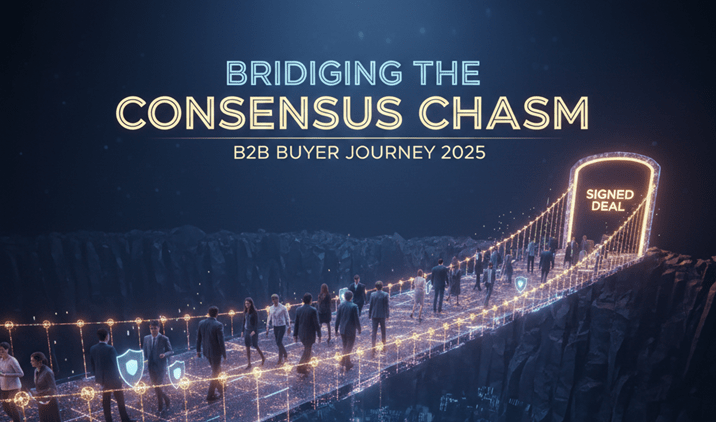
75% of sales representatives missed their quotas in 2024 as deal slippage surged to 34% and average sales cycles expanded by 20%. This isn’t just a market dip; it’s a fundamental architectural shift in how businesses buy. The universal problem facing B2B organizations today is the “Consensus Chasm”—the widening gap between an enthusiastic internal champion and the risk-averse external consultants or auditors who now hold the keys to the final contract.
The promise of this analysis is simple: to move your strategy from “persona-based selling” to “consensus-based enablement.” By the end of this document, you will understand how to equip your internal advocates to survive the scrutiny of third-party validation, turning a fragile “yes” into a signed deal.
This is essential reading for Marketing Directors and Sales Enablement Teams.
Core Analysis
1. The “Silent Seller” Dynamic (Internal Advocacy)
Concept: Advocacy Strength is the ability of an internal stakeholder to socialize a solution across the Decision-Making Unit (DMU) before formal vendor engagement. The Data: 81% of buyers initiate contact only after completing 69% of their journey. During this “silent” phase, the internal champion is your primary salesperson. High-performing deals—those with 9+ demo views—see close rates 8x to 10x higher because the champion has successfully distributed the vision. The So What: If your champion isn’t equipped with modular, shareable content, your deal will likely stall during the “messy middle” of internal evaluation, contributing to the 34% deal slippage rate currently plaguing the industry. Case in Point: A SaaS provider tracked their interactive tours and saw 14 views from compliance and finance. By providing the operations manager (the champion) with a specific “Security and ROI FAQ” for those departments, they shortened an 11.5-month cycle by 90 days.
/
2. The Rise of Third-Party Veto Power (External Scrutiny)

Concept: The “Scrutiny Coefficient” measures the friction introduced by external consultants or independent analysts who audit potential investments. The Data: 72% of buying teams now hire external consultants to validate critical investments. This involvement can double the sales cycle length (from 6.5 to 13.6 months) and nearly double the size of the buying committee (from 6.4 to 12.9 people). The So What: Branded marketing content is no longer enough; 44% of buyers trust impartial third-party content more than vendor-provided info. You must produce “consultant-grade” documentation—like ISO certifications and TCO models—to survive a professional audit. Case in Point: In a 2024 ERP procurement, a vendor survived a shortlist cut by providing audited financial statements and disaster recovery plans early. Three competitors were disqualified because they only focused on feature innovation, ignoring the consultant’s 30% weighting on “financial stability” and “compliance.”
3. The Multi-Threaded Mandate (DMU Complexity)
Concept: Multi-threading is the practice of running parallel outreach to all key stakeholders in the DMU concurrently rather than relying on a single point of contact. The Data: The average enterprise deal now involves 7 to 11 stakeholders, and in complex tech, that number can skyrocket to 22. 74% of these teams report “unhealthy conflict” during the evaluation process. The So What: Single-threaded sales motions are obsolete. Buying groups that reach a clear consensus are 2.5 times more likely to report a high-quality deal. You must address conflicting priorities—like the CFO’s focus on cash runway versus the end-user’s focus on UI—simultaneously. Case in Point: An ITSM vendor bypassed a procurement bottleneck by translating the champion’s “AI automation features” into a “Consensus Scoring Matrix.” This showed how AI reduced incident resolution times, which directly lowered the Total Cost of Ownership (TCO), satisfying both the technical and economic buyers.
The Strategic Implication
Actionable Recommendations:
- Orchestrate Parallel Engagement: Stop the linear “referral” chain. Send role-specific value props to the CFO (ROI models) and the IT Lead (API docs) at the same time to build departmental trust early.
- Deploy Internal Facilitation Kits: Give your champions modular “board-ready” decks and ROI calculators. If they look like experts in front of their boss, your deal’s survival rate triples.
- Scale via Interactive Demos: Use “Demolytics” to find hidden stakeholders. If a Legal head is viewing your security page four times, proactively send the champion a compliance whitepaper.
- Prioritize Third-Party Validation: Invest in co-branded content with analysts. It’s hard for a consultant to say “no” to your product when their own industry peers have already said “yes.”
Risk Mitigation: Avoid the “Lone Advocate Trap.” Relying solely on one champion to handle internal objections is a recipe for disaster. Champions are rarely professional sellers. If they give a weak answer to a skeptical CFO, your deal dies. Always use the champion to gain direct access to the wider committee rather than “coaching” them from the sidelines.
Future Outlook: Over the next 12-18 months, the B2B unit will become an AI-Assisted Buying Unit. By the end of 2025, more than half of large B2B transactions will be processed through digital self-serve channels, with 95% of buyers using GenAI to audit documentation. Success will depend on having “AI-ready” data—structured specs and transparent pricing that automated procurement agents can ingest in seconds.
Methodology
This analysis is based on a review of Q4 2024 earnings reports, a synthesis of 2025 buyer behavior reports from Gartner and Forrester, and an analysis of over 6 million buyer interactions with B2B product experiences.
Q&A
Q1: Why is my B2B sales cycle suddenly getting longer?
A: It’s likely due to the “Consensus Chasm.” With 72% of teams using external consultants, the audit process now takes longer than the actual product evaluation, often doubling cycle times.
Q2: How many stakeholders are typically involved in a B2B deal today?
A: The average is 7 to 11, but in enterprise technology, it can reach 22 stakeholders, requiring a multi-threaded engagement strategy.
Q3: What is the most effective way to help an internal champion?
A: Provide them with “Internal Facilitation Kits.” These should include customizable pitch decks and ROI calculators that help them justify the purchase to their internal board.
Q4: Do B2B buyers still want to talk to sales reps?
A: Increasingly, no. 71% of the B2B demographic are Millennials or Gen Z who favor “seller-free” journeys, completing 80% of their research online before ever reaching out.
Q5: What is the “Lone Advocate Trap”?
A: It is the mistake of relying on a single internal contact to sell your solution internally. Because they aren’t professional sellers, they often fail under scrutiny from CFOs or external auditors.
Conclusion
Recap: In 2025, the internal champion drives the vision, but the external consultant controls the validation. Final Insight: To stop deal slippage, you must equip your advocate with consultant-grade evidence that satisfies the entire multi-threaded committee. CTA: Audit your enablement library today for “CFO-ready” ROI tools; if your content isn’t audit-proof, your deals aren’t either.