Small business owners spend an average of 16 hours per week on administrative tasks like invoicing, data entry, and email tracking. This massive time sink directly caps the growth capacity of lean, early-stage businesses.
Many owners struggle to expand because they are stuck handling repetitive tasks manually. Manual administrative bottlenecks actively stall business growth and cause missed opportunities. Roughly 35% of small business leaders have missed real business chances because they were tied up in manual bookkeeping.
This post provides a clear blueprint to eliminate these repetitive administrative tasks on a minimal budget. You will learn how to connect affordable tools visually without hiring specialized software developers. Finding and applying the right low cost business automation ideas will save time and increase your operational capacity.
Why Do Manual Workflows Hinder Profit?

Only 4% of small businesses have fully automated their financial and bookkeeping processes. Meanwhile, 53% still manage their ledger and transaction tracking manually. This creates a concrete financial penalty that directly impacts the bottom line.
Consider a local commercial cleaning company managing a stack of paper receipts. Hand-reconciling transaction ledgers and entering invoice data manually consumes hours of weekly productivity. Human typing errors easily break this manual pipeline.
Failing to modernize means falling behind competitors quickly. Roughly 90% of small business owners are actively piloting artificial intelligence and automation integrations to protect their competitive market position. Manual operations will soon face severe competitive disadvantages.
Automation helps you reclaim wasted time and reduces operational error rates for repetitive data entry by up to 75%. Small businesses on tight budgets need to swap manual processes for automated workflows immediately.
The Simple Framework for Low Cost Business Automation Ideas
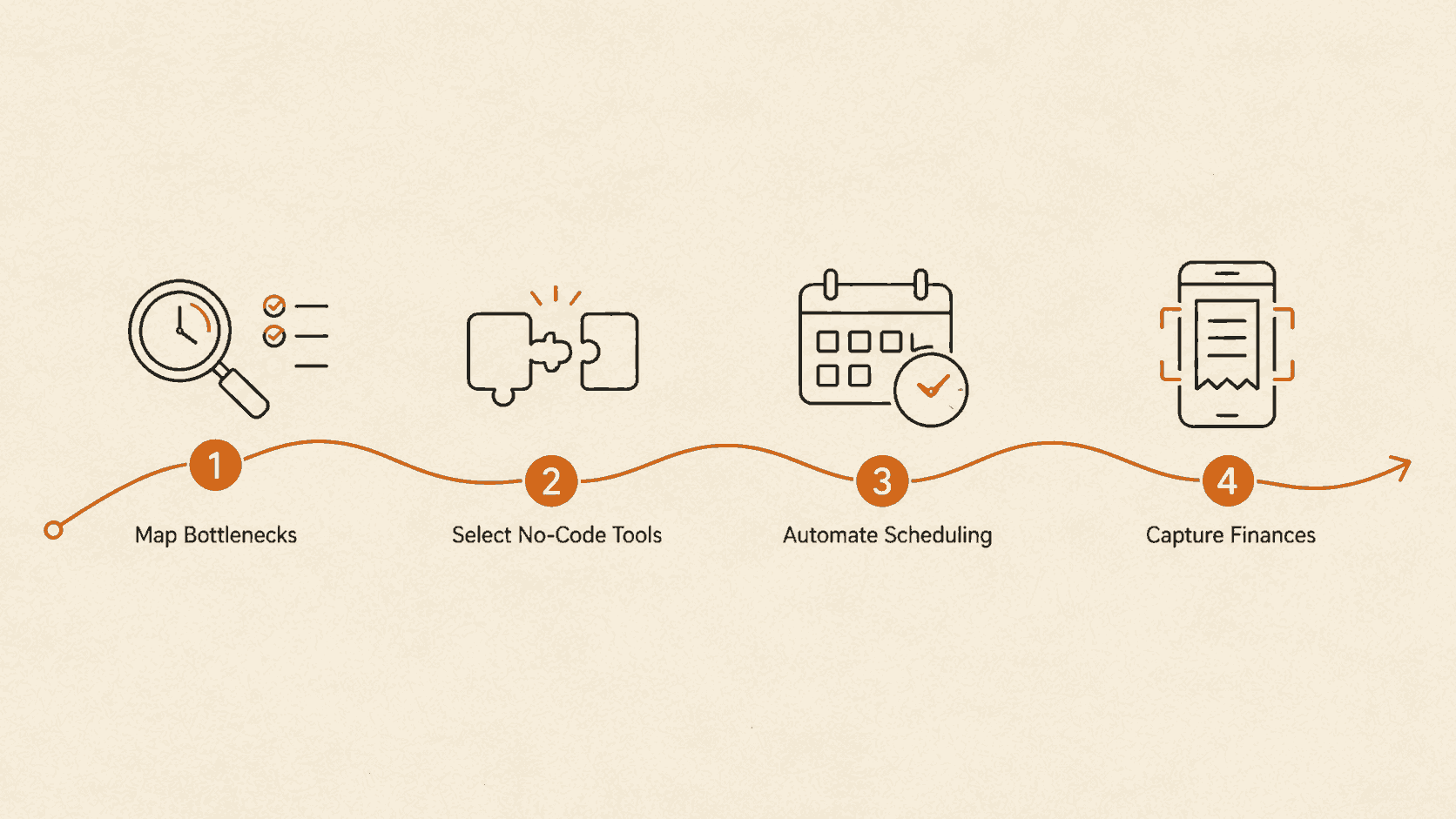
Transitioning to automated workflows does not require massive capital or a team of engineers. Follow these four steps to build your own system.
- Map Your Current Bottlenecks Identify the tasks that eat your time, such as manual data entry or email tracking. Small business owners lose 541 hours per year to manual admin, which represents over 67 working days. Pinpointing these specific drains is the first step to reclaiming your time.
- Select No-Code Middleware Cloud-based integration platforms allow unrelated applications to communicate automatically via a visual drag-and-drop interface. This approach eliminates the need for custom coding. An independent contractor can connect an online quote request form directly to Google Sheets, Slack, and Gmail without paying for a developer.
- Deploy Asynchronous Scheduling Manual back-and-forth emails for meeting coordination drain productivity. Implement booking portals that sync with your digital calendar to let clients self-select appointments and pay upfront. This setup reduces costly client no-shows by 30% to 50% through automated reminders.
- Automate Financial Capture Use software with optical character recognition to scan and archive expense data. Applications extract vendor names, transaction dates, and tax details from a simple smartphone photo. This keeps financial records audit-ready in real-time and reduces monthly bookkeeping labor.
Implementing these low cost business automation ideas often yields a return on investment of 200% to 240% within the first 12 months. Start with one process and build from there.
Three Dangerous Mistakes to Avoid
- Building Overly Complex Integrations: Attempting to construct massive, multi-branch integrations immediately is a critical error. This structural approach increases the probability of broken integration paths and quickly overwhelms limited technical capacity.
- Ignoring Scheduling Boundaries: Failing to set up strict buffer times and daily meeting limits causes chaos. Automated schedulers without boundaries can create overlapping bookings or fill your schedule entirely, leaving no time for client delivery.
- Trusting Categorization Blindly: Trusting automated ledger-categorization engines without establishing manual validation thresholds leads to financial trouble. This lack of oversight can result in incorrect tax codes, missed write-off opportunities, or undetected bank synchronization errors.
Frequently Asked Questions
How do I start automating my business when I have zero coding experience?
You can start implementing low cost business automation ideas by adopting no-code middleware platforms. These cloud-based integration platforms allow unrelated software applications to communicate via a visual drag-and-drop interface. You entirely eliminate the need for custom programming to connect your tools.
Is it safe to automate my bookkeeping and monthly ledger reconciliation?
Yes, it is safe to automate bookkeeping if you establish manual validation thresholds. Automated data synchronization acts as a reliable structural quality-control mechanism. Transitioning to automated workflows reduces operational error rates for repetitive data entry by up to 75% when managed correctly.
How does automated client booking help reduce customer meeting cancellations?
Automated scheduling portals reduce costly client no-shows by 30% to 50% through automated SMS and email reminders. Clients self-select appointments and receive automatic notifications without manual intermediary coordination. This immediately ends the frustrating back-and-forth email chains that waste your valuable work time.
What are the best free-tier tools to start automating operations?
Make, Zapier, Calendly, and HubSpot CRM offer excellent free-tier options for small businesses. Make provides 1,000 free operations per month for visual workflow orchestration. These affordable tools represent some of the best low cost business automation ideas available for a startup or micro-team.
How can I measure the actual financial return of business automation?
Calculate the return on investment by comparing the value of reclaimed labor hours against monthly software subscription costs. Standardized business process automation yields an average return on investment of 200% to 240% within the first 12 months. This proves the value of your initial setup time.
Automating repetitive administrative tasks delivers immediate time savings and protects your profit margins.
Audit your weekly schedule today to identify the one specific task that drains your time. Pick a simple tool like a booking portal or an expense scanner to handle that single bottleneck.
Take action now to improve your operational efficiency. Leave a comment below sharing the manual process you plan to automate first.

Leave a Reply
You must be logged in to post a comment.