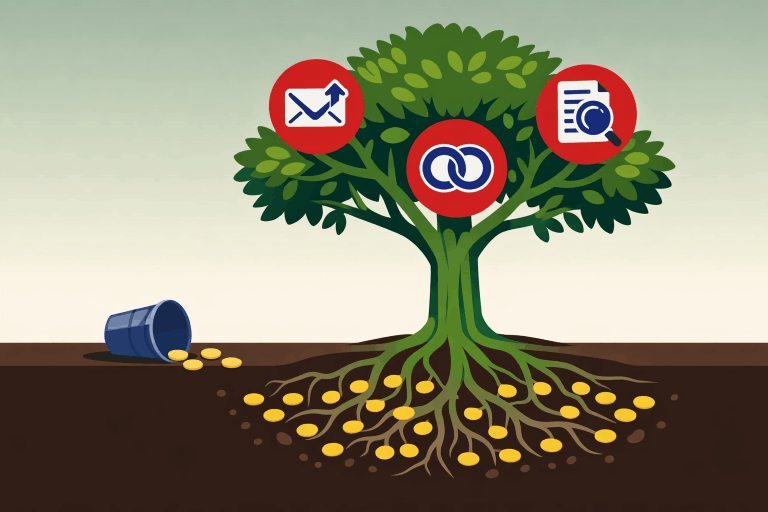
Customer acquisition costs jumped 29% in a single year. That number is quietly dismantling the “just run more ads” model for small businesses everywhere. Paid channels are getting more expensive, delivering fewer results, and most small business owners are already feeling it in their margins.
The assumption killing small business growth is that marketing requires money. The most effective organic growth strategies for small business cost nothing — they run on the customer relationships, knowledge, and systems you already have. Most owners are sitting on a referral engine, a content opportunity, and an email list that none of them are being used properly.
By the end of this post, you will know how to retain more of the customers you already have, build a referral engine that brings in new ones at no cost, create content that earns search traffic without paid promotion, and use free AI tools to do more with less time. These are the organic growth strategies for small business that do not require an ad budget — and all of them start with what you already have.”

THE CORE PROBLEM
Why Paid Growth Is Getting Harder for Small Businesses to Afford
Organic search accounts for 53% of all website traffic. Paid search drives just 15%. That gap is not a coincidence. It reflects where real buying intent actually lives online.
Picture a local bookkeeper who relied on Google Ads for leads. In 2023, the budget was manageable. By 2024, her acquisition costs had jumped 29% and her ad spend was producing a fraction of the leads it once did.
She stopped the ads and started publishing specific, helpful tax content on her website. Within months she had more inbound inquiries than she could take on. The shift was not luck. It was a system.
Small businesses with fewer than 20 employees cannot outspend large competitors in paid channels, and the algorithms are not designed in their favour. The businesses growing in 2025 are building owned assets: email lists, referral networks, and content libraries that keep working long after the original effort is done.
Paid traffic stops the second the budget runs out. That is why organic growth strategies for small business are the only long-term model that makes sense at this budget level.

THE FRAMEWORK
4 Organic Growth Strategies Small Business Owners Can Start Today
There is no single tactic that builds sustainable growth. It is a system, and the four steps below are designed to work together. Each one builds on the previous.
1. Secure What You Already Have : Stop the leak before trying to fill the bucket. Most small businesses spend time chasing new customers while losing existing ones to silence. Automated email follow-ups sent within three to seven days after a first purchase significantly increase the chance of a second sale. Email marketing returns $36 for every $1 spent. If you have an email list and no follow-up sequence, fixing that is the highest-ROI move you can make this week.
2. Build a Referral Engine: 83% of customers are willing to refer a business they genuinely like. Only 29% ever do, and research shows 60% of the rest say the reason is simple: no one ever gave them a link or asked. A double-sided referral program rewards both the referrer and the new customer. Over 78% of successful referral programs use this structure because it removes the social awkwardness of “getting a kickback” and turns sharing into gift-giving.
3. Create One Pillar Content Piece Per Month: A single, in-depth guide targeting a specific customer problem can drive qualified organic traffic for years without ongoing spend. Businesses ranking first for a keyword with 10,000 monthly searches capture 2,050 visitors. Businesses ranking ninth on the same term capture only 552. Depth and specificity are the competitive advantage available to any small business willing to do the work large brands won’t.
4. Put Free AI Tools to Work on Repetitive Tasks: Only 19% of B2B marketers have fully integrated AI into their daily workflows. The businesses in that group are generating two to three times the output without adding headcount. Free and freemium tools like ChatGPT or Claude can draft your first content outline in minutes, handle FAQ email responses, and free up hours every week for the high-value work that actually builds relationships. The barrier to starting is a free account and 30 minutes.”

MISTAKES TO AVOID
3 Common Mistakes That Stop Organic Growth Before It Starts
Pricing on cost instead of customer value. Setting prices based solely on internal expenses plus a margin ignores what the market is actually willing to pay. This approach quietly hands significant revenue to competitors who position the same service as a premium solution.
Assuming satisfied customers will refer you automatically. Satisfaction is not a referral system. Without a prompt, a link, and an incentive, most customers who would happily recommend your business simply never get around to it, taking that referral potential with them.
Publishing short, generic content to tick a box. A 500-word post covering a topic already answered by hundreds of other sites does nothing in 2025’s search environment. AI-generated answers fill basic queries instantly. The only content that builds organic authority is specific, detailed, and genuinely more useful than anything else on the topic.

FREQUENTLY ASKED QUESTIONS
What are the highest-ROI free marketing tactics for small businesses in 2025?
Email marketing and referral programs deliver the strongest returns with no ad spend required. Email generates $36 for every $1 spent. Referral programs produce four times higher ROI than digital advertising. Together, these two tactics address both retention and acquisition, making them the ideal starting point for any business without a marketing budget.
How do I set up a referral program without expensive software?
Start with a simple double-sided incentive: a reward for both the person referring and the new customer they send. Over 78% of successful referral programs use this dual-reward structure. Promote it through your existing email list and manage early referrals manually with a spreadsheet before investing in dedicated tracking software.
How long does it take to see results from organic content and SEO?
Organic content typically takes three to six months to gain meaningful search visibility. The trade-off is that the content keeps working after you stop. A well-constructed guide targeting a specific customer question can drive qualified traffic for years, unlike paid ads that stop the moment the spend does.
Can a small business really compete with large brands using only organic growth strategies?
Yes, by targeting specific, narrow search terms that large brands overlook. Long-tail keywords account for 70% of all search traffic. A small business that answers one focused customer question better than anyone else can consistently outrank larger competitors on that topic, regardless of budget size or domain authority.
What metrics should I track to know if my organic growth strategies are working?
Track three numbers: referral participation rate (what percentage of customers have shared your referral link), organic search traffic month over month, and email open and click rates. These three metrics map directly to the three core organic pillars: advocacy, content, and retention. Together they give a clear picture of where to focus next.
CONCLUSION
Growing a small business without a marketing budget is not about shortcuts. It is about building three systems that compound over time: a referral engine that activates your existing customers, an authority content library that earns search traffic, and an email relationship that keeps buyers coming back.
The single best action to take today is to email your existing customer list and ask for a referral. Keep it direct, offer a real incentive for both sides, and make the sharing process easy. That one step activates the 83% of customers who are willing to refer but have never been prompted.
Have these organic growth strategies made a difference in your business? Drop a comment below and share what has worked, or head over to our related post on building a high-converting email list from scratch to take the next step.



Leave a Reply