
Over 80% of small business failures are linked to cash flow mismanagement.
That’s not because owners don’t work hard. It’s because many don’t fully understand what their numbers are saying—especially their P&L.
A profit and loss statement (P&L) shows whether your business is actually making money. But for most owners, it just looks like a wall of numbers.
This article breaks it down in plain English. You’ll learn how to read each section, what to look for, and how to spot problems early.
This article is specifically written for small business owners who get monthly financial reports but aren’t sure how to use them to make decisions.
How to read a P&L statement for small business step by step
Start at the top. Always.
Revenue (also called the “top line”) is the total money your business earns before expenses. According to industry data, over 85% of small businesses report stable or increasing revenue, but that doesn’t guarantee profit.
Next comes Cost of Goods Sold (COGS)—the direct cost to deliver your product or service. For example, materials or labor tied directly to a job.
Now calculate gross profit:
Gross Profit = Revenue − COGS
If you make $10,000 in revenue and spend $4,000 on COGS, your gross profit is $6,000.
Then come operating expenses (rent, marketing, salaries). Subtract these from gross profit to get operating income (also called EBIT—earnings before interest and taxes).
Finally, subtract interest and taxes to reach net profit, also called the “bottom line.”
Only 46% of small businesses were profitable in 2024, which shows why understanding this flow matters (src: small business statistics reports).
✅ Quick Win: Read your P&L top to bottom once a month—don’t skip straight to profit.
What each section actually tells you about your business
Each section answers a different question.
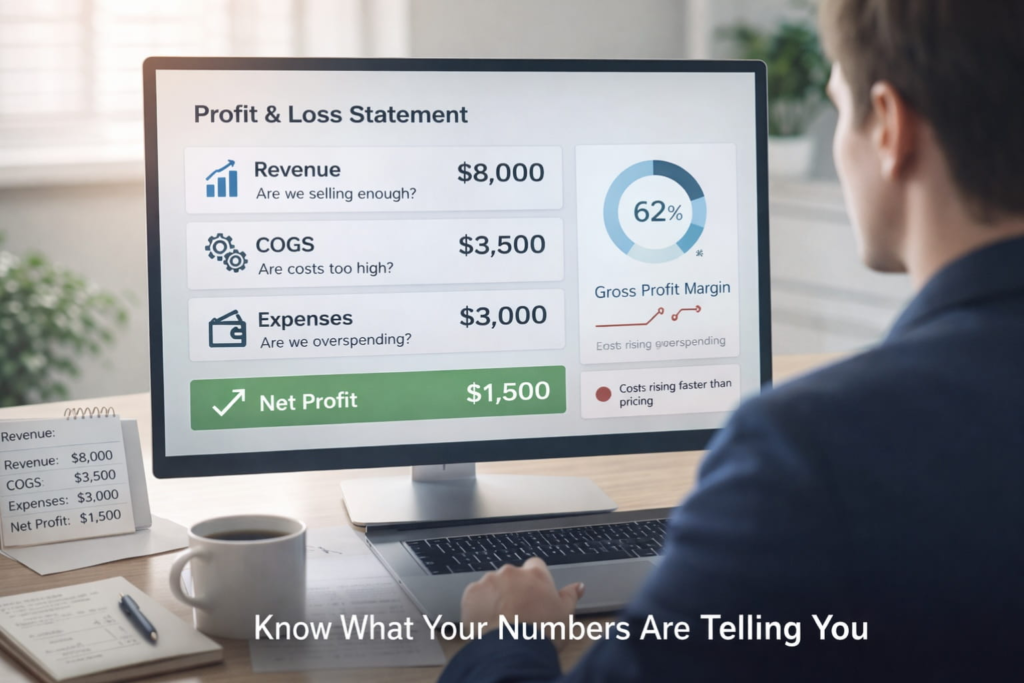
Revenue tells you: “Are we selling enough?”
COGS tells you: “Is delivery too expensive?”
Operating expenses tell you: “Are we overspending to run the business?”
One critical metric is gross profit margin—the percentage left after COGS.
Gross Profit Margin = Gross Profit ÷ Revenue × 100
If your margin drops, your costs are rising faster than your pricing. This has become common, with more than 50% of small businesses reporting rising supplier costs (according to 2026 data).
Then look at operating expenses. These include fixed costs (rent) and variable costs (ads, supplies). Only 31% of businesses actively optimize cash flow, meaning most react too late when costs rise.
Example:
Sarah runs a 3-person cleaning business. She earns $8,000/month.
COGS (cleaners’ wages + supplies) = $3,500
Operating expenses (rent + marketing) = $3,000
Net profit = $1,500
If her wages increase, her profit shrinks fast—even if revenue stays the same.
✅ Quick Win: Track your gross margin monthly. If it drops, investigate immediately.
Why your P&L shows profit but your bank account is empty
This confuses almost every business owner at some point.
Your P&L shows profit, but your bank balance says otherwise. This is called the profit–cash gap.
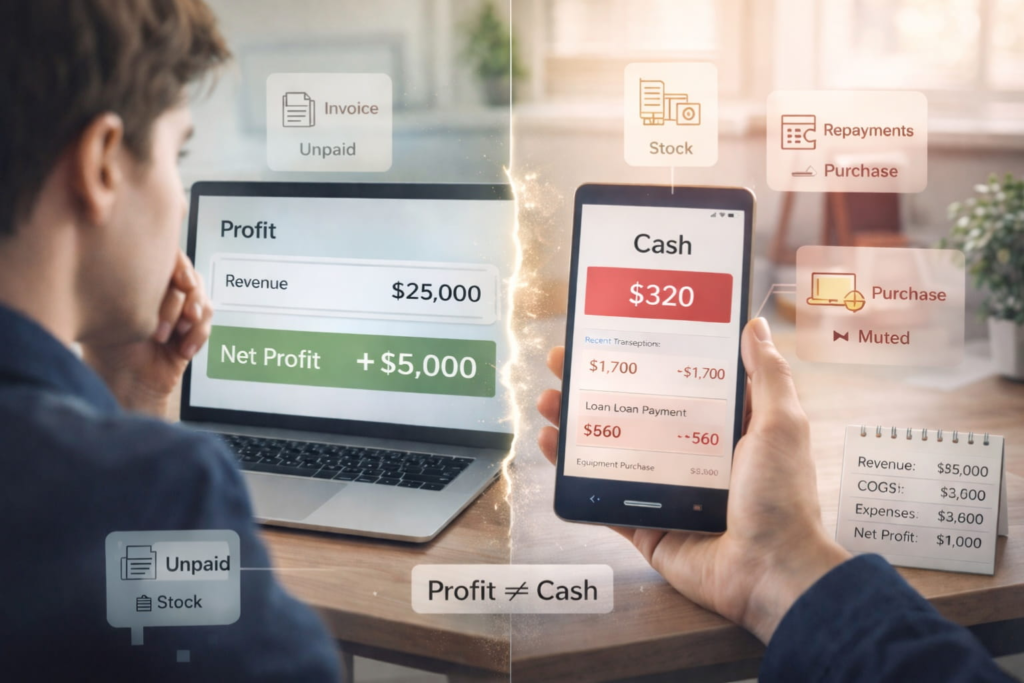
According to financial data, 82% of businesses fail due to cash flow issues—even when they appear profitable.
Here’s why:
- Accounts receivable: You made a sale but haven’t been paid yet
- Inventory: You spent cash, but it’s not counted as an expense yet
- Loan principal: Only interest shows on the P&L, not repayments
- Big purchases: Buying equipment affects cash, not immediate profit
Example:
You invoice $5,000 this month. It shows as revenue.
But if the client pays next month, your bank account doesn’t reflect it yet.
Also, if you buy a $2,000 laptop, your cash drops immediately—but the P&L spreads that cost over time.
That’s why the P&L is about profitability, not cash.
Your P&L shows profit. This shows what happens to your cash.
The Cash Flow & Runway Dashboard maps your next 13 months — inflows, fixed costs, variable costs, burn rate, and runway — in one sheet. Free, no signup.
[Download: Cash Flow & Runway Dashboard →] (Excel / Google Sheets — works for any business)
✅ Quick Win: Always review your P&L alongside your bank balance and unpaid invoices.
FAQ
How often should I review my P&L statement?
A: At minimum, review your P&L monthly. This helps you spot trends early, like rising costs or falling margins. Weekly reviews work even better for businesses with tight cash flow or high expenses.
What is the difference between gross profit and net profit?
A: Gross profit is revenue minus direct costs (COGS). Net profit is what’s left after all expenses, including rent, salaries, interest, and taxes. Net profit shows your true earnings.
How do I read a P&L statement for small business if I hate numbers?
A: Focus on 3 numbers only: revenue, gross profit, and net profit. Track how they change over time. You don’t need to understand everything—just follow the flow of money.
What is a good profit margin for a small business?
A: It depends on the industry. Many small businesses aim for a 5%–10% net profit margin. Compare your numbers to similar businesses to understand if you’re performing well.
Why does my P&L not match my bank balance?
A: Because P&L uses accounting rules, not cash movement. It includes unpaid invoices, excludes loan repayments, and spreads large costs over time. That’s why profit and cash are often different.



Leave a Reply
You must be logged in to post a comment.